


 support@thepetbotique.com
Table of Contents
- Why Pet Owners Seek Only Natural Pet Alternatives for Toys
- What Makes Safe Materials for Pet Toys
- Top Non-Toxic Dog Toys for Every Play Style
- Durable Chew Toys for Aggressive Chewers
- Interactive and Enrichment Toys for Boredom Busting
- How to Verify Third-Party Safety Certifications
- Lifecycle and Durability: Getting More from Every Toy
- Conclusion
- Frequently Asked Questions
Last Updated: September 30, 2026
Why Pet Owners Seek Only Natural Pet Alternatives for Toys
Shoppers searching for Only Natural Pet alternatives for toys usually aren't chasing a trend. They're reacting to something real: a toy that split open in a week, a squeaker that vanished down a throat, or a label that promised "natural" without explaining what that meant. Owners want toys that are genuinely safe, genuinely durable, and genuinely worth the money, and the mainstream options keep falling short on at least one of those counts.
What Makes Safe Materials for Pet Toys
Safe materials for pet toys are those that resist breakdown under repeated chewing, contain no known endocrine-disrupting additives, and hold their shape long enough that no small parts break loose. The U.S. Consumer Product Safety Commission guidance on children's product safety offers a useful reference point, since the same logic about small parts and material integrity applies to anything a pet mouths.
Materials to Look For
- Natural rubber: Bounces back after chewing instead of cracking. Look for a matte finish and a rubbery, not plastic, smell.
- ETPU foam: Expanded thermoplastic polyurethane. Lightweight, chew-resistant, and used in many burst-ball designs because it rebounds instead of compressing flat.
- Organic cotton and hemp fiber: Plant-based, low-shedding, and good for rope toys. Hemp in particular resists mildew better than cotton when a toy gets slobbered on.
- Food-grade silicone: Soft on gums and easy to clean. It tolerates heat, so it can be boiled between uses.
- Recycled materials: A solid zero-waste option when the weave is tight. Loose recycled fiber sheds and can be ingested.
Materials to Avoid
- Soft PVC: Often softened with phthalates, which are used as plasticizers. Phthalates are the additive most commonly flagged because they can leach out of soft plastic over time, especially when chewed.
- Cheap plush with loose stitching: A leading cause of swallowed stuffing. If you can pull a seam apart with two fingers, a determined dog will too.
- Painted or dyed plastics: Chips can flake off over time, and paint is not formulated for ingestion.
- Anything with a strong chemical smell: A sign of residual solvents or off-gassing. A toy that smells like a new shower curtain is not a toy you want in a mouth.
Why "BPA-Free" and "Phthalate-Free" Are Not the Same Claim
BPA (bisphenol A) is a building block used in some hard polycarbonate plastics (Bisphenol A (BPA)). Phthalates are plasticizers used to make soft PVC flexible. They are different chemicals with different uses, and a toy can be free of one while still containing the other. A hard plastic toy labeled "BPA-free" tells you nothing about whether the soft grip attached to it contains phthalates.
When a listing says "non-toxic" with no further detail, look for the specific claim: "food-grade silicone," "phthalate-free PVC," "natural rubber." A specific material name is a stronger signal than a general safety word.
Top Non-Toxic Dog Toys for Every Play Style
The best non-toxic dog toys are the ones that match how your dog actually plays, not the ones with the longest feature list. A fetch-obsessed retriever and a lap-cat that bats at strings need completely different designs, and buying against that grain wastes money.
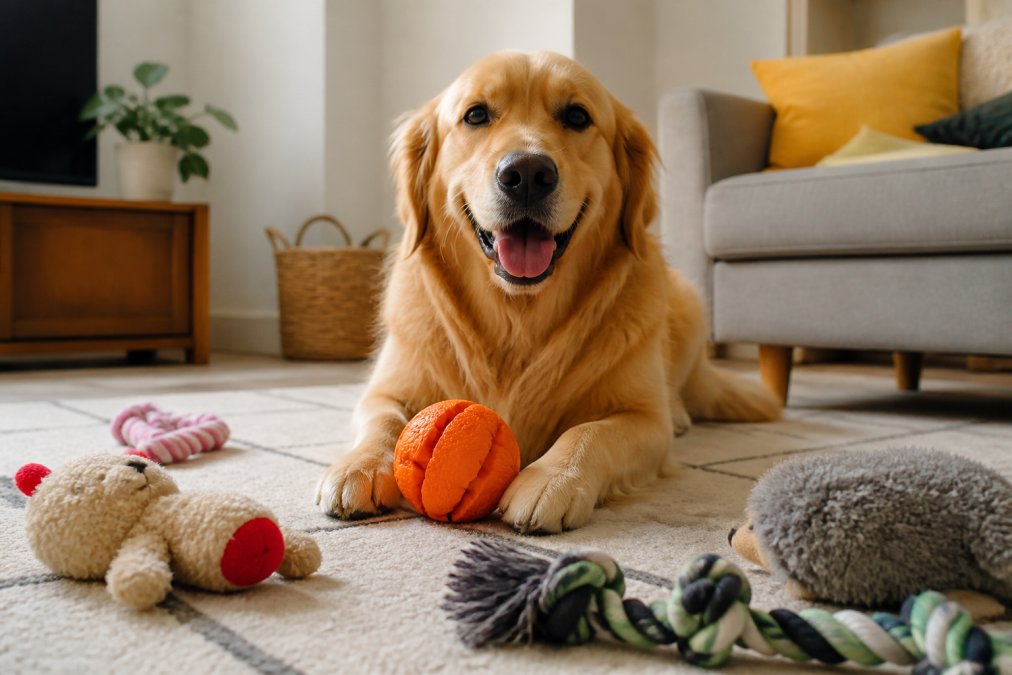
Here's how the picks break down by play style:
| Toy | Price | Best For | Play Style |
|---|---|---|---|
| Chew-Resistant Burst Ball | $14.99 | Cats and dogs, all sizes | Fetch, solo chew |
| Rope Tug Toy | $19.99 | Dogs and cats, all ages | Tug, dental chew |
| Interactive Dog Soccer Ball | $19.99 | Medium and large dogs | Fetch, water play |
| Pet Chew Toy | $14.99 | Dogs of all sizes | Cuddle, light chew |
| Stingray Rope Toy | $59.99 | All breeds | Chase, tug-of-war |
Durable Chew Toys for Aggressive Chewers
Durable chew toys for aggressive chewers need to survive sustained pressure without fracturing into sharp edges. That rules out most plush and thin-walled plastic, and it's why material choice matters more than size or shape.

Interactive and Enrichment Toys for Boredom Busting
Interactive and enrichment toys work by giving your pet a problem to solve, and that mental effort tires them out faster than physical play alone. For dogs left alone during the workday, this is often the difference between a calm evening and a shredded couch cushion.
How to Verify Third-Party Safety Certifications
Third-party safety certification verification means checking that an independent lab, not the manufacturer, tested the product for material safety. This is the step most buyers skip, and it's the one that separates a genuinely safe toy from a well-marketed one.
Here's a practical checklist:
- Look for a named testing body, not a vague "lab-tested" claim
- Check that the certification covers the specific material, not just the brand
- Confirm the certification is current, not expired
- Search the testing organization's public database for the product
- Ask the retailer directly which standards the toy was tested against
Lifecycle and Durability: Getting More from Every Toy
Lifecycle analysis of pet toys comes down to one question: how many months of safe play do you get per dollar? A cheap toy that fails in two weeks costs more over a year than a well-made one that lasts six months, and it carries a higher risk of swallowed parts. But the lifecycle question doesn't end at failure. What happens to the toy after it's destroyed is the part almost every guide skips, and it's where the zero-waste conversation actually gets useful.
A Concrete Weekly Inspection Protocol
Run this check every week, and after every heavy chew session:
- Seam test. Hook a thumb into each seam and pull gently. If stitching separates, the toy is done.
- Squeaker test. Squeeze the toy and feel for the squeaker's position. If it has shifted toward an opening, retire the toy before it becomes a choking hazard.
- Surface test. Run a fingernail along the material. If it flakes, cracks, or leaves a residue, the material is breaking down.
- Attachment test. Tug every rope, tab, and appendage. A part that moves independently of the body is a part that can be swallowed.
- Odor test. A sour or chemical smell after washing means bacteria or off-gassing has set in. Replace it.
Age-Specific Safety Requirements
Generic toy advice fails because a puppy, an adult, and a senior have different mouths and different risks.
- Puppies (teething): Gums are sore and teeth are sharp but not yet strong. Soft rubber and fabric with no loose parts work best. Avoid hard nylon, which can chip developing teeth.
- Adults: This is where chew-resistant materials earn their keep. Match hardness to the dog's jaw strength, not its size, a small terrier can out-chew a large lazy breed.
- Seniors: Dental sensitivity and weaker jaws mean low-impact enrichment is safer than tug or hard chew. Snuffle toys and soft food-dispensing puzzles keep the mind engaged without stressing teeth.
What Happens After the Toy Dies
Most pet toys end up in a landfill, and most are made from mixed materials, fabric sewn to plastic, rope knotted through rubber, which makes them hard to recycle even when the individual materials are recyclable. A few practical options:
- Single-material toys (all-rubber, all-rope) are the easiest to retire responsibly. Check whether your municipal program accepts them.
- Fabric and rope toys that are still structurally sound can be donated to shelters, which go through tug toys constantly.
- Destroyed plush can sometimes be composted if the filling is natural fiber and the outer shell has no synthetic dye, but check local rules first.
- The simplest reduction is buying fewer, better toys and rotating them, which spreads wear and delays replacement.
Conclusion
Finding a toy that's actually safe, actually durable, and actually engaging shouldn't require guesswork. At The Pet Botique, we stock interactive toys, cozy beds, and reliable care essentials built for exactly that standard, and you can save 10% when you buy any two items, with free shipping on orders over $65. Start with a chew-resistant ball or a snuffle toy and see the difference a well-made product makes.
Frequently Asked Questions
What is the safest material for dog toys?
Natural rubber, organic cotton, hemp fiber, and food-grade silicone are among the safest materials for dog toys. These materials are free from BPA, phthalates, and other harmful chemicals that can leach when pets chew. Look for toys labeled non-toxic and phthalate-free. For example, the Interactive Dog Soccer Ball is made from non-toxic PU material, and the Chew-Resistant Burst Ball uses durable ETPU. Always check for third-party safety certifications to confirm material safety.
How do I choose non-toxic toys for my pet?
Start by reading labels and looking for terms like BPA-free, phthalate-free, and non-toxic. Avoid toys with strong chemical odors, which can indicate harmful substances. Choose toys made from natural rubber, organic cotton, or hemp fiber rather than synthetic plastics. Check for third-party certifications like Green Seal or EcoLogo. For durable chew toys for aggressive chewers, opt for chew-resistant materials like ETPU. The Pet Botique's Interactive Dog Soccer Ball is made from non-toxic PU material, and the Pet Dog Chew Toy Molar Toothbrush is described as safe and non-toxic.
Are there eco-friendly and sustainable pet toy options?
Yes, many brands now offer eco-friendly pet toys made from recycled materials, natural rubber, or plant-based fibers like hemp. These toys reduce environmental impact and are often safer for pets. Look for toys with minimal packaging and those that are biodegradable or recyclable. The Dog Snuffle Toy, for instance, uses pineapple fleece fabric, a sustainable material. Choosing durable, long-lasting toys also reduces waste, supporting a zero-waste approach to pet care.
What are durable alternatives to natural rubber pet toys?
If you need durable chew toys for aggressive chewers, consider ETPU (used in the Chew-Resistant Burst Ball) or tough nylon and PU materials. These materials withstand heavy chewing while remaining non-toxic. The Pet Dog Chew Toy Molar Toothbrush is made from soft, elastic, yet tough material that resists vigorous chewing. For interactive play, the Stingray Rope Toy combines a plush stingray with a 10ft tug rope, offering durability and engagement. Always supervise chewing to ensure safety.
How can I tell if a pet toy is truly non-toxic?
Look for explicit labels like non-toxic, BPA-free, and phthalate-free. Research the brand's transparency about materials. Third-party certifications such as Green Seal or EcoLogo provide independent verification. Avoid toys with vague material descriptions or strong chemical smells. The Pet Botique's Interactive Dog Soccer Ball is made from non-toxic PU material, and the Pet Dog Chew Toy Molar Toothbrush is described as safe and non-toxic. When in doubt, contact the manufacturer for details.
Choosing the right toy for your pet means balancing safety, durability, and engagement, and that balance looks different for every household. The Pet Botique makes it simpler with a curated range of interactive toys, durable chew designs, and comfort essentials, plus 10% off when you buy any two items and free shipping on orders over $65. Get started with The Pet Botique and give your pet playtime that actually holds up.


