


 support@thepetbotique.com
Table of Contents
- Why Do Pet Toys Fall Apart? The Real Reasons
- Why Dogs Destroy Toys: Instinct, Boredom, and Energy
- How Toy Design Creates Weak Points
- Durable Dog Toys for Aggressive Chewers: What Actually Holds Up
- How to Choose Safe Dog Toys: A Practical Checklist
- When to Replace Dog Toys: Damage Inspection Guide
- Conclusion
- Frequently Asked Questions
Last Updated: October 12, 2026
Why Do Pet Toys Fall Apart? The Real Reasons
Pet toys fall apart because of three things: your dog's chewing instincts, the materials, and how the toy is built. When any one is weak, the toy loses. Most toys fail at predictable points, once you know where to look, you can spot a weak toy before your dog gets it.
Chewing Behavior and Destructive Play
Chewing isn't misbehavior, it's how dogs explore, relieve stress, and keep their jaws strong. Play style matters more than breed or size: a small shredder can wreck a plush toy faster than a large dog that just carries toys. Watch how your dog plays, steady gnawing, pinning and pulling seams, or shaking and ripping, and that pattern tells you what toy to buy.
- Gnawers need firm, solid chew toys
- Shredders need toys without loose stuffing or thin fabric
- Tuggers need reinforced stitching and strong rope
Material Quality and Construction Flaws
Material choice decides how long a toy survives. Soft fabric tears fast. Cheap plastic cracks. Thin rubber splits at the edges.

Construction matters just as much, a toy with good material still fails at a weak seam or single stitch line.
Here's what to check before you buy:
- Material: firm rubber, silicone, or dense rope outlast thin plush
- Seams: double-stitched edges hold; single-stitched edges rip
- Weight: a toy that's too light for your dog gets destroyed faster
Why Dogs Destroy Toys: Instinct, Boredom, and Energy
Dogs destroy toys for reasons that have nothing to do with being "bad." Instinct tops the list: chewing and ripping mimic hunting and eating. Boredom runs a close second, a dog left alone for hours needs an outlet, and if the only thing within reach is a toy, that toy takes the beating.
- Give your dog a real workout before you leave
- Rotate toys so they feel new again
- Add puzzle feeders and snuffle mats for mental work
If your dog destroys toys mostly when you're gone, the toy isn't the whole problem. The day is.
How Toy Design Creates Weak Points
Every toy has a spot where it fails first, designers call these weak points, owners call them "the part that ripped." Ask where a determined jaw would do the most damage: usually a seam, an opening, or where two materials meet.
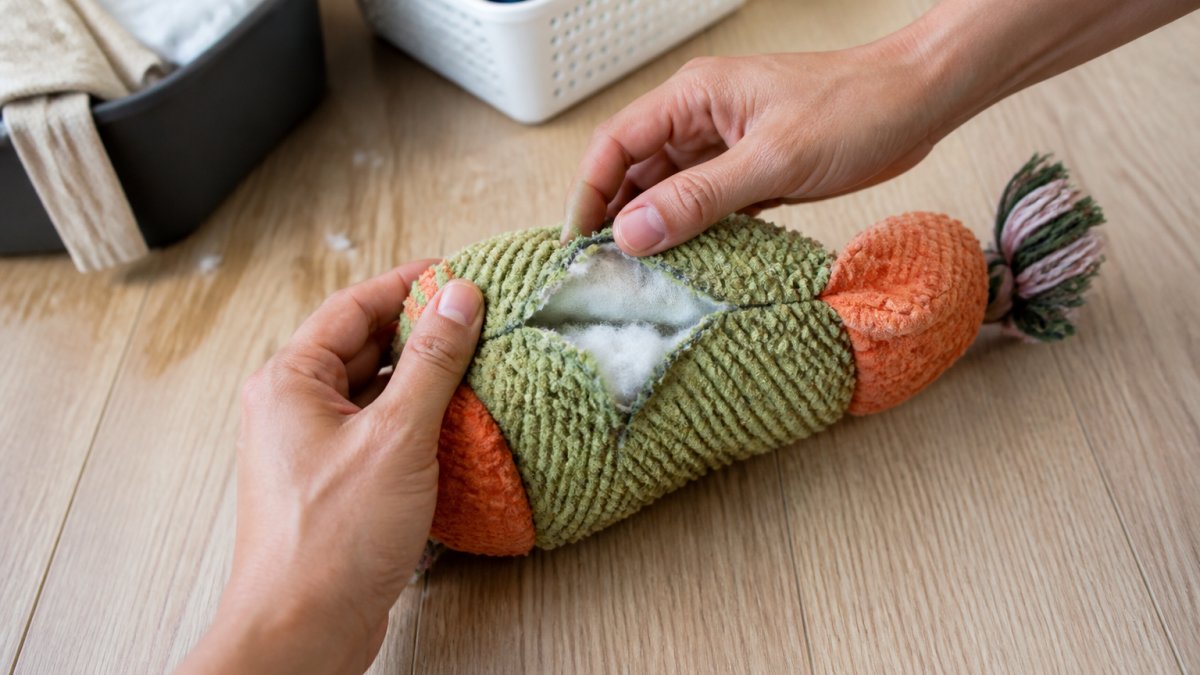
Seams, Stitching, and Stuffing Failures
Seams are the top failure point on soft toys: a single stitch line pops under steady pulling, and once it opens, stuffing comes out fast. Stuffing is a safety issue, not just a mess, a dog that swallows stuffing or squeaker parts can end up with a blockage and a vet visit. Reinforced seams, double stitching, and strong edge binding buy time.
Why Soft and Plush Toys Tear First
Plush toys tear first because they're built for comfort, not combat, soft fabric, thin thread, and loose filling are easy to grab and rip.
That doesn't make plush bad, it's great for gentle players and dogs who cuddle a toy at night.
But if your dog's goal is to shred, plush is short-lived. Match the toy to the player, or treat plush as "supervised only."
- Best for gentle chewers and cuddlers
- Keep for supervised play, not alone time
- Check for tears after every session
Durable Dog Toys for Aggressive Chewers: What Actually Holds Up
Durable toys for aggressive chewers share firm material, no loose parts, and reinforced construction. Silicone, dense rubber, and strong rope top the list.

The American Kennel Club's guidance on safe dog chews notes that toy choice should match a dog's size, chew style, and energy level.
For heavy chewers, choose toys with no squeaker, no stuffing, and no thin edges.
A Diagnostic Guide: Why Your Last Toy Actually Failed
Most owners replace a destroyed toy without learning why it failed, then buy the same type and watch it die the same way. Run the failed toy through this four-question diagnostic before you shop.
1. Where did it break?
- At a seam: construction failure. The stitching was single-line or the edge binding was thin. Fix: look for double-stitched or reinforced seams, or switch to a one-piece molded toy with no seam at all.
- Through the middle of the material: material failure. The fabric, rubber, or plastic was too soft for your dog's jaw strength. Fix: move up a durability tier, thicker rubber, denser rope, or a solid molded body.
- At a hardware point (squeaker, plastic ring, tag loop): design failure. The toy had a small part that became a grab point. Fix: choose toys with no attached hardware.
2. How long did it last?
- Under an hour: mismatched to your dog's chew style, not defective, a fit problem.
- A few days to a week: borderline fit; a tougher material or larger size may solve it.
- Weeks to months: appropriate toy, expected wear, routine replacement.
3. What was your dog doing when it failed?
- Gnawing steadily: jaw strength beat the material, go firmer.
- Pinning and pulling at seams: a shredder, avoid stitching or stuffing.
- Shaking and ripping: a dissector, the toy needs to be one solid piece.
4. Was your dog supervised?
Sausage-Shaped Pet Chew Toys →
- Yes, and it still failed fast: the toy was undersized or underbuilt for that dog.
- No: it may have been fine for supervised play but not solo chewing, many failures happen in the first unsupervised hour.
Matching the Fix to the Failure
| Failure Point | Likely Cause | Targeted Fix |
|---|---|---|
| Seam split | Single stitching, thin binding | Double-stitched or seamless molded toy |
| Material tore through | Too soft for jaw strength | Thicker rubber, dense rope, or solid body |
| Squeaker or hardware pulled out | Attached small parts | Hardware-free design |
| Even wear, no single tear | Normal service life | Replace same type, inspect weekly |
| Failed in under an hour | Fit mismatch | Resize up and move up a durability tier |
A Selection Method by Size and Chew Style
Once you know why the last toy failed, use this checklist to pick the next one:
- Size: too large to fit fully in your dog's mouth and too large to swallow. When in doubt, size up.
- Jaw strength: a dog that dents a rubber toy with steady pressure needs a firmer tier.
- Play style: gnawers need solid chew toys; shredders need seamless, stuffing-free toys; tuggers need reinforced rope; chasers can use lighter toys.
How to Choose Safe Dog Toys: A Practical Checklist
Safe dog toys match your dog's size, chew style, and play habits. There's no single "best" toy, only the best fit.
Use this checklist before you buy:
- Toy is sized for your dog, not too small to swallow
- No loose parts, small squeakers, or weak plastic
- Material flexes but doesn't crack or splinter
The FDA's pet food and product safety information reminds owners to watch for wear and replace damaged items.
A common mistake is buying a toy that's too small, anything that fits in your dog's throat is a choking risk, no matter how tough.
When to Replace Dog Toys: Damage Inspection Guide
Replace a dog toy the moment it shows deep cracks, exposed stuffing, or missing pieces. Small damage turns into big risk fast.
Check your dog's toys weekly: squeeze, bend, and inspect the seams. If a toy fails any check, it's done.
The Weekly Inspection Routine
A two-minute check per toy catches most hazards before your dog does:
- Squeeze the whole toy. Soft spots, thinning walls, or areas that give way more than they used to mean it's weakening.
- Bend it at every seam and joint. Cracks, white stress lines, or splitting at the edges mean the material is fatigued.
- Look inside openings. Visible stuffing, filler, or the inside of a squeaker chamber means the outer shell has failed.
- Tug gently on attached parts. Squeakers, rings, tags, and rope knots should not move or separate under light pull.
- Run a finger along all edges. Sharp edges, rough spots, or exposed plastic can cut your dog's mouth or gums.
- Smell it. A strong chemical or sour odor can mean degraded material or trapped bacteria.
If a toy fails any step, move it out of reach immediately, don't leave it in the bin for your dog to find.
Discard vs. Repair: A Clear Rule
Most soft toys aren't worth repairing, once stuffing is exposed, ingestion risk outweighs a patch. Use this rule:
- Discard immediately: exposed stuffing, missing squeaker, cracked hard plastic, sharp edges, chewed-off pieces, or any toy your dog has partially swallowed.
- Repairable (tough fabric only): a clean seam split on a flat, stuffing-free fabric toy, with no missing pieces and no exposed filler. Patch with heavy fabric and strong thread, then re-inspect before the next use.
- Never repair: plush toys with hidden stuffing, toys with internal squeakers, or any toy where you can't see the full extent of the damage.
Cleaning Without Weakening the Toy
How you clean a toy affects how long it lasts, harsh methods break down material faster than chewing does.
- Rubber and silicone: warm water and mild dish soap, rinse, air dry. Skip the dishwasher unless labeled safe, heat can warp or crack some materials.
- Rope: machine wash in a mesh bag on gentle, then air dry completely. A damp rope left in a bin can grow mold.
- Plush: spot clean when possible; if machine washing, use cold water and air dry, heat shrinks fabric and loosens stitching.
A Replacement Schedule That Works
There's no fixed calendar, but these intervals keep most households ahead of failures:
- Soft and plush toys: inspect after every play session; expect a short lifespan with any dog that shreds.
- Rope toys: inspect weekly; replace when strands fray, loosen, or pull out.
- Rubber and silicone chew toys: inspect weekly; replace at the first crack, split, or change in firmness.
Redirecting the Urge to Shred
If your dog destroys toys faster than you can inspect them, the drive to rip and dig needs a non-toy outlet. Supervised shredding, a cardboard box filled with treats, a snuffle mat, or a puzzle feeder, lets your dog work that instinct without stuffing or plastic in reach.
When you restock, focus on the items your dog uses daily rather than a bin of toys that die in a week. A smaller, better-matched set is easier to inspect, rotate, and keep safe.
Conclusion
Pet toys fall apart for reasons you can predict and plan around. Match the toy to your dog's chewing style, check materials and seams, and inspect often, that's how you stop wasting money on toys that die in a week.
At The Pet Botique, explore our for humans collection, our most popular line, alongside cozy beds and blankets that round out a happier home. Get started with The Pet Botique and give your pet toys that last.
Frequently Asked Questions
Why do dogs destroy their toys?
Dogs destroy toys for several reasons: natural chewing instinct, boredom, excess energy, or anxiety. Some dogs are genetically inclined to shred, while others do it out of frustration. Providing durable dog toys for aggressive chewers and interactive alternatives can redirect that behavior. If your dog consistently destroys toys within minutes, it may need tougher materials or more mental stimulation.
Is it normal for dogs to rip the stuffing out of toys?
Yes, it's common, but it's not safe to ignore. Once stuffing is exposed, ingestion risk rises. Swallowed stuffing can cause choking or intestinal blockage. If your dog loves shredding, try toys without stuffing or offer supervised shredding sessions with safe materials. Always inspect toys after play and remove any loose pieces immediately.
How can I tell if a pet toy is unsafe?
Check for torn seams, exposed squeakers, loose strings, or missing chunks. Any toy that has been deformed or has sharp edges should be discarded. Also look for small parts that could break off and become a choking hazard. When in doubt, throw it out. Supervised play and regular damage inspection are your best tools.
What types of toys are best for dogs that destroy toys?
Look for toys made from durable materials like ETPU, reinforced rubber, or thick silicone. Avoid plush toys unless used only for supervised gentle play. Chew-resistant balls and sturdy chew toys designed for aggressive chewers last longer. Rotate toys to keep interest high and reduce wear on any single item.


