


 support@thepetbotique.com
Table of Contents
- Why Bulky Plastic Crates Fall Short in a Real Home
- How to Choose an Aesthetic Crate Alternative (Appearance, Footprint, Durability, Price)
- Dog Crate Furniture: The End Table That Doubles as a Kennel
- Dog Playpen for Home: More Space Without the Plastic Box
- Indoor Dog Gate: Containment You Can Fold Away
- Crate Training Alternatives: When a Covered Bed Does the Job
- Chewing, Escape Risk, and Matching the Setup to Your Dog
- Conclusion: Pick the Setup That Fits Your Dog and Your Room
- Frequently Asked Questions
Last Updated: October 8, 2026
Why Bulky Plastic Crates Fall Short in a Real Home
A plastic dog crate does its job, but it rarely earns its place in a living room. The aesthetic alternatives to bulky plastic dog crates here solve a problem most shoppers notice only after the box arrives: the thing is enormous, it clashes with everything, and it never folds away.
A standard plastic kennel eats floor space whether your dog is inside it or not. It blocks sightlines, traps odors, and looks like luggage in a bedroom corner. Wire crates are lighter but show every scratch and dent.
What replaces one? Not a single product, but a short list of setups that look intentional: furniture-style kennels, playpens, foldable gates, and covered beds.
Below, we'll walk through each option and which dogs it suits, plus where each one fails, because not every alternative contains a determined chewer.
How to Choose an Aesthetic Crate Alternative (Appearance, Footprint, Durability, Price)
Start with three questions: what does it look like, how much floor does it take, and will it survive your dog? Answer honestly and the choice usually makes itself.
Appearance matters more than people admit. A piece that matches your furniture stops reading as "pet equipment."
Footprint is the sneaky one. A crate alternative that holds a 70-pound dog needs roughly the same square footage as the crate it replaces. The difference is whether that space works double duty, like an end table or a gated corner.
Durability comes down to your dog, not the label. Calm dogs do fine in cloth and canvas; chewers need structure they can't pull apart.
Use this quick filter before you buy:
| Priority | Best Option | Watch Out For |
|---|---|---|
| Looks like furniture | Furniture-style kennel | Heavy, hard to move |
| Folds away fast | Foldable gate or playpen | Not for climbers |
| Maximum floor space | Gated room or playpen | Needs supervision |
| Chew-proof containment | Traditional crate | Bulky appearance |
| Small dogs and puppies | Covered bed or small pen | Outgrown quickly |
Dog Crate Furniture: The End Table That Doubles as a Kennel
Dog crate furniture is a kennel built into a table, bench, or cabinet, so it functions as a normal piece of your room, containment plus a surface for a lamp or books.
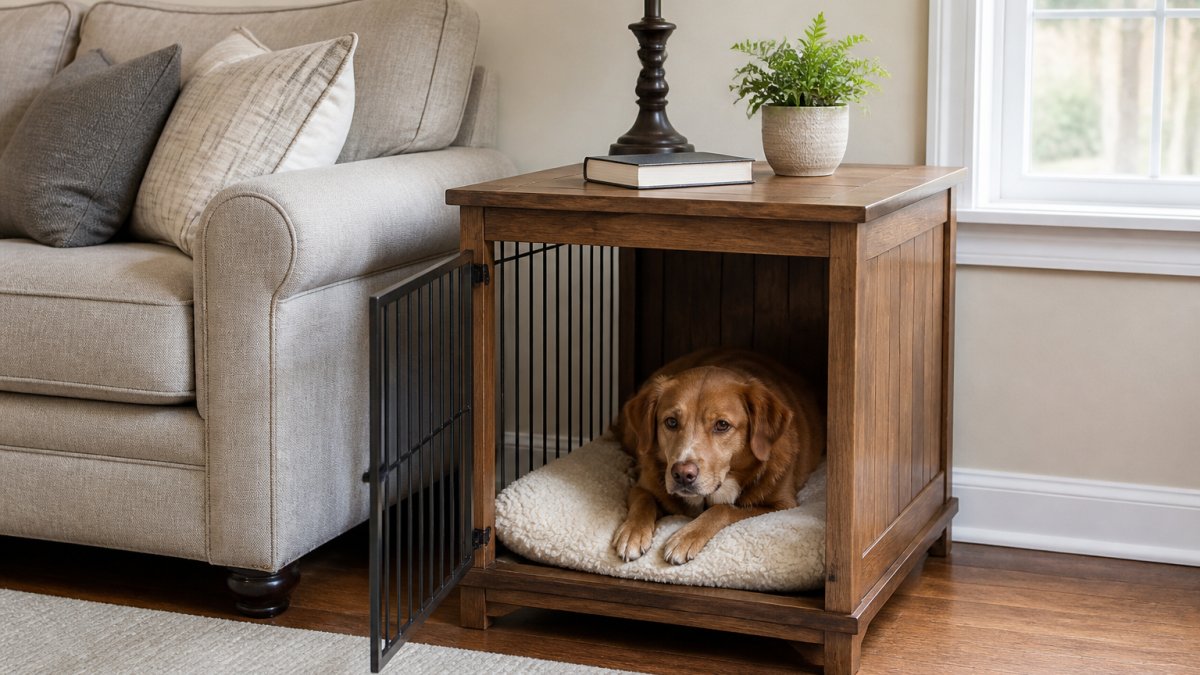
This is the closest thing to a true crate replacement, and our top pick for adult dogs who already accept a crate. The kennel doesn't disappear, but it stops looking like one.
Two things to check before ordering. First, weight: solid wood units are heavy, so measure your doorway. Second, airflow, a cabinet-style kennel with a solid back runs warm, so look for slatted sides or a mesh panel.
For the inside, a fitted pad makes the difference between a dog who uses it and one who avoids it. Our Plush Dog Crate Bed for Large Dogs is machine-washable and keeps its shape.
Dog Playpen for Home: More Space Without the Plastic Box
A dog playpen for home gives your dog room to stand, turn, and stretch without confining them to a single box. It's the better choice for puppies, multi-pet households, and anyone who feels guilty about crate hours.
Pens come in two broad types.
Here's the sizing rule that prevents a second purchase.
Neither pen type is escape-proof. A determined climber will go over the top, and a strong chewer can work at fabric seams.
Where a pen wins is flexibility. You can shape it around a corner, attach it to a crate, or shrink it during house training and expand it as your puppy grows.
Cleaning and ventilation are the two things buyers regret ignoring. Fabric pens collect hair in the seams and hold odor, so look for removable, machine-washable covers. Wire pens wipe down easily but let drafts through.
If you want a pen setup that reads as part of the room rather than a cage, pair it with a bed your dog actually chooses. A Soft Dog Bed for Large Dogs in 100% cotton works indoors or on the road, and it gives the pen a clear "rest here" zone.
Indoor Dog Gate: Containment You Can Fold Away
An indoor dog gate is the lightest containment option here, and the one most people overlook. Instead of boxing your dog in, you block a doorway, hallway, or stairwell and let them keep the room.
Foldable cloth gates are the practical pick for renters and small apartments. They store flat, weigh almost nothing, and don't require drilling into a door frame. Our Black Foldable Protection Pet Safety Gate is built from strong, breathable cloth with a sleek black finish, and it comes in two sizes: 43.3 x 28.3 inches and 70.9 x 28.3 inches.

That breathable fabric matters more than it sounds. Solid barriers cut airflow and sightlines, which stresses some dogs; a cloth gate keeps your dog visually connected while still setting a boundary.
Black Foldable Protection Pet Safety Gate →
The honest limitation: a gate is a boundary, not a container. It works for calm dogs and short absences. It is not a substitute for a crate during a thunderstorm or a long workday.
Crate Training Alternatives: When a Covered Bed Does the Job
Crate training alternatives make sense once your dog is past the destructive phase and simply wants a den to retreat to. For those dogs, a covered bed replaces the crate entirely.
The logic is simple.
Before you retire the crate, run this graduation check:
- Your dog has gone at least a month without chewing furniture, baseboards, or bedding.
- Your dog has gone at least a month without an indoor accident when left alone for a normal stretch.
- Your dog chooses to nap in the crate or a corner on their own, not only when told.
- Your dog settles within a few minutes of you leaving the room.
If any of those fail, keep the crate and add a covered bed inside it as a comfort layer. That way the bed becomes a familiar scent and surface before it becomes a standalone sleeping spot.
Our 25'' Semi Enclosed Pet Bed uses a plush cave design with a non-slip bottom, sized for cats and small dogs. For a slightly larger footprint, the Comfortable Semi-enclosed Cat Nest measures 21 x 21 x 15 inches and suits shy or anxious pets who want privacy.


Two practical notes. First, enclosed beds run warmer than open ones because body heat stays inside the cave, in a warm room or for a thick-coated dog, that can push them out entirely.
Here's where this option fails. A covered bed offers zero containment. If your dog still chews baseboards or has accidents, a bed isn't a crate replacement yet, it's the reward you graduate to.
For senior dogs or larger breeds, support matters as much as enclosure. A Washable Large Orthopedic Dog Bed with a removable, washable cover handles both the comfort and the cleanup, and it fits inside most furniture-style kennels if you want the den feel without giving up containment.
Chewing, Escape Risk, and Matching the Setup to Your Dog
The wrong setup fails for one of two reasons: your dog destroys it, or your dog escapes it. Matching the option to your dog's temperament prevents both.
Run your dog through this before you buy:
- Does your dog chew furniture, baseboards, or bedding? If yes, skip fabric pens and covered beds.
- Has your dog ever climbed out of a pen or over a gate? If yes, choose a roofed or solid-sided option.
- Does your dog panic when separated from you? If yes, start with a crate and add a pen gradually.
- Is your dog a puppy under six months? Expect to size up within a year.
- Is your dog calm and non-destructive? A bed or gated room is likely enough.
A common mistake is buying the prettiest option first and discovering the temperament mismatch later. Buy for the dog you have, not the dog in the photo.
Ventilation and cleaning matter too. Cloth and canvas collect hair and hold odors, so anything machine-washable saves real effort over a year. Solid furniture units need a wipe-down and a vacuum inside. Enclosed designs run warmer, so check airflow before you commit.
Conclusion: Pick the Setup That Fits Your Dog and Your Room
The best aesthetic alternatives to bulky plastic dog crates aren't a single product. They're a matched pair: one option for containment, one for comfort, chosen around your dog's temperament and your room's layout.
If your dog is calm and crate-trained, start with a furniture-style kennel and a plush pad inside. If you're still in the chewing and house-training stage, keep the crate and add a foldable gate or pen for daytime boundaries.
At The Pet Botique, we stock the pieces that make either path work, from foldable safety gates and semi-enclosed beds to washable orthopedic beds. You can save 10% when you buy any two items, and shipping is free on orders over $65.
Get started with The Pet Botique and build a setup your dog settles into and your room still looks good with.
Frequently Asked Questions
What can I use instead of a plastic dog crate?
Four practical swaps cover most homes: dog crate furniture that doubles as an end table, a dog playpen for home use, an indoor dog gate for doorways and stairs, or a covered semi-enclosed bed for dogs that just want a den. Each keeps your dog contained or settled without a plastic box in the middle of the room. The right pick depends on whether you need full confinement, a temporary boundary, or simply a calm resting spot.
Are furniture-style dog crates safe for dogs?
They can be, as long as the frame is sturdy, the door latches securely, and there are no gaps a paw or jaw can wedge into. Measure your dog standing and lying down, then add a few inches so they can turn around comfortably. Check the latch weekly and tighten any hardware. For heavy chewers, inspect the interior panels regularly, since wood can splinter where a determined dog has been working at an edge.
Can a dog bed replace a crate?
For a calm, non-destructive dog, often yes. A semi-enclosed bed gives the same sense of a den, which is what many dogs actually want from a crate. It will not work for a puppy in the middle of house training, a dog with separation anxiety, or a chewer who needs a secure enclosure. Think of a bed as a crate training alternative for settled adult dogs, not a full substitute for every stage.
What is a good crate alternative for a dog that dislikes confinement?
A dog playpen for home use or a gated dog-proofed room usually works better than a closed crate for dogs that panic in tight spaces. Both give your dog room to move, stand, and see out while still setting a boundary. Pair the open area with a covered bed so there is a place to retreat. Introduce the new setup gradually with treats and short sessions before leaving your dog alone in it.
How do I choose a crate alternative for a large dog?
Start with the footprint. Measure the floor space you can give up, then compare that against your dog's full stretched-out length, not just their height. A large dog needs a sturdy frame, so prioritize durability over decorative detail, and check weight ratings on any bed you buy. A washable orthopedic bed with a non-slip base holds up better under a big dog than a lightweight plush option.


