


 support@thepetbotique.com
Table of Contents
- Orthopedic vs Memory Foam Pet Beds for Joint Pain: What's the Difference?
- Quick Comparison: Orthopedic Foam vs Memory Foam Pet Beds
- Orthopedic Foam vs. Memory Foam: How They Actually Differ
- Choosing an Orthopedic Dog Bed for Arthritis and Joint Pain
- Memory Foam Dog Bed Downsides You Should Know
- How to Evaluate Foam Quality Before You Buy
- Matching the Bed to Your Dog's Size, Sleep Style, and Condition
- Conclusion: Which Bed Type Is Right for Your Dog?
- Frequently Asked Questions
Last Updated: October 13, 2026
Orthopedic vs Memory Foam Pet Beds for Joint Pain: What's the Difference?
Orthopedic pet beds and memory foam pet beds are not competing categories. Memory foam is one material an orthopedic bed can be built from. That single distinction decides most buying questions before you compare anything else.
Here is the practical version. An orthopedic bed is any bed engineered to distribute a dog's weight and reduce pressure on joints, hips, and spine. A memory foam bed is one that uses viscoelastic foam as its cushioning layer.
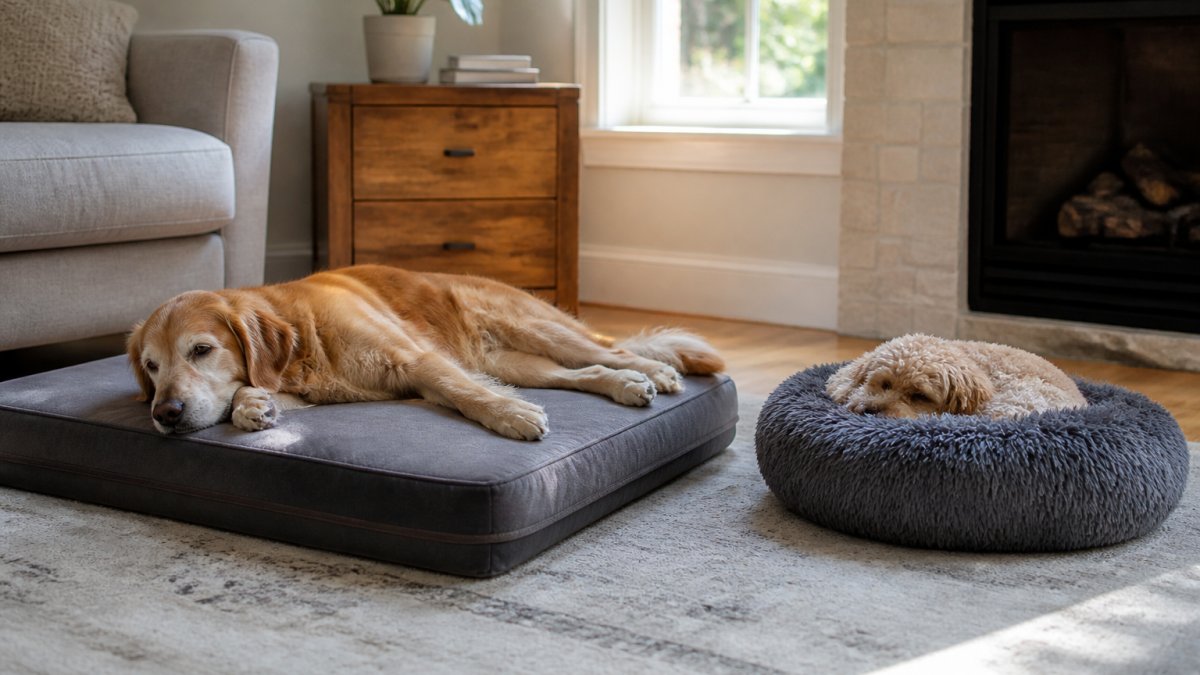
Quick Comparison: Orthopedic Foam vs Memory Foam Pet Beds
The short answer: orthopedic foam beds suit most dogs with joint pain because they hold their shape under weight, while memory foam beds feel plusher but can compress too far for heavy or arthritic dogs. Use this table as your starting filter, then read the sections below for the reasoning.
| Feature | Orthopedic Foam Bed | Memory Foam Bed |
|---|---|---|
| What it is | A category: any bed built for pressure relief | A material: viscoelastic foam used as a comfort layer |
| Main job | Support joints, hips, and spine | Conform to body shape |
| Weight distribution | Spreads load across the foam core | Molds to contact points |
| Best for | Senior dogs, large breeds, arthritis, hip dysplasia | Light and medium dogs, dogs who like to sink in |
| Heat retention | Lower, especially with a removable plush topper | Higher, foam traps body heat |
| Recovery after pressure | Springs back quickly with dense foam | Slower return, can stay compressed |
| Care | Look for removable, washable covers | Same, but foam itself should not be soaked |
Orthopedic Foam vs. Memory Foam: How They Actually Differ
Orthopedic foam is built to push back. Memory foam is built to give way. That is the whole difference in one line, and it explains nearly every trade-off that follows.
An orthopedic bed's job is to keep your dog's body from sinking to the floor. The foam core resists compression, so weight spreads across the whole sleeping surface instead of concentrating at the elbows, hips, and shoulders. The term covers several materials: high-density foam, supportive foam, egg-crate foam, and yes, memory foam when it sits on top of a firm base.
Memory foam does something different. It warms with body heat and softens, then molds to the dog's shape. That contouring feels luxurious, and for a dog with mild joint issues it can take pressure off bony spots.
What Orthopedic Foam Does for Joint Support
Joint support comes from resistance, not softness. A dog with arthritis or hip dysplasia needs a surface that stops the body from sinking into the floor, because a dog lying flat on a hard surface puts direct pressure on the exact spots that hurt.
Three things matter in an orthopedic bed:
- Foam density. Denser foam holds up longer and resists compression under a heavy dog.
- Foam thickness. A thicker core gives more room for weight to spread before the dog reaches the bottom.
- Recovery. Good foam springs back after your dog stands up. Foam that stays dented has stopped doing its job.
Support for bones and the spine works the same way. When the sleeping surface stays level, the spine is not forced into a curve and the hips are not twisted. For senior dogs and large breeds, that difference shows up in how easily they get up after a long nap.
How Memory Foam Conforms to Your Dog's Body
Memory foam's strength is body contouring. It softens with heat and molds to the dog's shape, which spreads pressure across a wider area than a flat, firm surface would. For a dog with soft tissue problems or one recovering after surgery, that gentle conforming support can be genuinely comfortable.
The honest limitation: memory foam is a comfort layer, not a foundation. On its own, a thick memory foam bed can compress until your dog is effectively lying on the floor. It also runs warmer than other foams because it traps body heat, which matters for double-coated breeds and for dogs who already run hot.
Choosing an Orthopedic Dog Bed for Arthritis and Joint Pain
An orthopedic dog bed for arthritis should be firm enough to keep your dog off the floor and easy enough to clean that you actually maintain it. Those two requirements eliminate a surprising number of options.
Start with your dog's weight and sleep style, not the marketing copy. A dog who sprawls out needs a flat, wide surface. A dog who curls into a ball does well with a bed that has raised edges to lean against.
Then match the bed to the condition:
- Arthritis. Prioritize firm, high-density support and a surface that does not trap heat.
- Hip dysplasia. Look for a wide, flat sleeping area so the hips are not forced into a tight curl.
- Post-surgical recovery. A bed with a removable, washable cover matters more than plushness here.
- Senior dogs generally. Lower entry height and a non-slip base so the bed does not slide when they push up.
Our Washable Large Orthopedic Dog Bed is built around a thick, supportive sponge foam base that resists sinking, with a removable zippered cover and a waterproof lining for accidents. It comes in four sizes from Medium up to 2XL, with the largest supporting dogs up to 99 lbs.

Memory Foam Dog Bed Downsides You Should Know
Memory foam dog bed downsides come down to three things: heat, compression, and cost of ownership.

Heat is the first issue. Memory foam traps body heat to do its job, which is fine in a cool room and miserable for a thick-coated dog in summer.
Washable Large Orthopedic Dog Bed →
Compression is the second. Memory foam recovers slowly by design. Under a heavy dog, that slow recovery can turn into a permanent dent, and a dented bed offers no pressure relief. Firmness and recovery matter more than the memory foam label itself.
The third issue is care. Memory foam should not be soaked, so you need a bed with a removable cover you can actually wash. Beds without that feature tend to get retired early, which is a poor return on a higher upfront price.
How to Evaluate Foam Quality Before You Buy
Foam quality is measurable, and the specs you need are usually buried in the product listing. Learn to read four numbers and you can judge a bed without touching it.
- Density. Higher density means more foam material per unit of volume, which means it resists compression longer. Listings that state density are usually the ones worth considering.
- Thickness. Thicker cores spread weight further before a dog bottoms out. A thin comfort layer over nothing is not support.
- Firmness. Firm enough to hold your dog's weight without collapsing, soft enough that pressure points are cushioned.
- Recovery. Press the foam if you can, or read reviews for the phrase "stayed flat." Foam that does not spring back is worn out.
If a listing gives you none of these, treat the "orthopedic" label as unverified. A bed described only as "plush" or "ultra-soft" is describing comfort, not support, and those are not the same promise.
Matching the Bed to Your Dog's Size, Sleep Style, and Condition
The right bed for a 15 lb terrier with mild stiffness is not the right bed for a 90 lb shepherd with hip dysplasia. Size and sleep style narrow the field faster than any other filter.
For large-breed dogs, surface area and weight capacity come first. A bed that is too small forces your dog into a curl, which concentrates pressure on the hips.
For dogs who like to nest, a bed with raised edges gives them something to lean against and can help anxious dogs settle.
For travel and crate use, portability beats thickness.
Conclusion: Which Bed Type Is Right for Your Dog?
If your dog has joint pain, start with the category, not the material. Choose an orthopedic bed with a firm, dense support layer, then decide whether a memory foam comfort layer on top is worth the extra heat and cost for your dog. For most dogs with arthritis or hip dysplasia, firm support beats plush contouring.
For dogs with only mild stiffness or a preference for sinking into a soft surface, a memory foam bed with a solid base underneath is a reasonable pick. Just check the base, not the label.
If you are not sure where your dog falls, our team at The Pet Botique can help you match a bed to your dog's size, sleep style, and condition.
Frequently Asked Questions
Is orthopedic foam the same as memory foam?
No. Orthopedic foam is a broad category covering any dense, supportive foam that resists compression and distributes weight evenly, such as high-density sponge foam. Memory foam is a specific type of polyurethane foam that softens with body heat and molds to the sleeper's shape. A bed labeled orthopedic may use memory foam, high-density foam, or a combination, so check the material listed, not just the label.
What are the downsides of memory foam dog beds?
Memory foam retains body heat, which can make dogs uncomfortable in warm weather or if they run hot. It also tends to be softer, so very heavy dogs may sink rather than stay supported. Some memory foam beds take time to recover their shape after compression, and the foam itself cannot be washed, only the cover. If your dog overheats easily or weighs over 80 pounds, a high-density orthopedic foam bed may work better.
Does memory foam help dogs with arthritis?
Memory foam can help dogs with arthritis by conforming to pressure points and reducing concentrated weight on sore joints. However, its benefit depends on foam density and thickness. A thin memory foam layer over soft stuffing will compress under a large dog and offer little relief. For arthritis, look for a bed with at least 3 to 4 inches of supportive foam, whether memory foam or high-density orthopedic foam, so the dog's weight is distributed rather than bottoming out.
How thick should an orthopedic dog bed be for joint pain?
For most dogs with joint pain, a bed with 3 to 4 inches of supportive foam is a good starting point. Smaller dogs may do well with 2 to 3 inches, while large breeds and seniors often need 4 inches or more to prevent their hips and elbows from pressing through to the floor. Thickness alone is not enough; the foam must also be dense enough to resist flattening under your dog's weight.
Do small dogs need orthopedic beds?
Small dogs can benefit from orthopedic beds, especially seniors, those with arthritis, or dogs recovering from surgery. A small dog's joints still bear weight, and a supportive surface reduces pressure on the spine and limbs. That said, small dogs have less mass pressing into the foam, so a 2 to 3 inch orthopedic bed is often sufficient. If your small dog is young and healthy with no joint issues, a plush bed may be fine.
Sorting through joint-pain beds gets overwhelming fast when every listing claims to be orthopedic. The Pet Botique carries a range of orthopedic and plush beds with removable, washable covers, firm foam bases, and non-slip bottoms, so you can match the bed to your dog instead of guessing from a label. Buy any two items and save 10%, and enjoy free shipping on orders over $65. Get started with The Pet Botique and give your dog a bed that actually supports their joints.


