


 support@thepetbotique.com
Table of Contents
- Why Pet Safety Gates Matter for Your Home
- Pressure-Mounted vs Hardware-Mounted Pet Gates: Which Works Best
- How to Measure for a Pet Gate That Fits Your Doorway
- Best Tall Pet Gates for Large Dogs: Preventing Jumps and Escapes
- Materials and Durability: Metal, Wood, and Mesh Options
- Safety Features and Locking Mechanisms You Need
- Installation Tips for Renters and Homeowners
- Frequently Asked Questions
Last Updated: September 19, 2026
Why Pet Safety Gates Matter for Your Home
Pet safety gates restrict your pet's access to specific areas, protecting both animals and belongings while giving you peace of mind without constant supervision.
Pet safety gates prevent scenarios like pets injuring themselves on stairs, accessing toxins, or destroying furniture or chewing electrical cords.
This guide covers gate types, measurement techniques, and safety features to help you choose the right pet safety gate for your situation.

Pressure-Mounted vs Hardware-Mounted Pet Gates: Which Works Best
The first major decision is whether you want a pressure-mounted or hardware-mounted gate. This choice determines how much damage you'll accept to your home and how secure your containment needs to be.
Pressure-mounted gates use tension to stay in place without tools or installation. Setup takes minutes and removal leaves no marks, ideal for renters.
Trade-off: they work only in openings with solid surfaces on both sides and can shift under determined pressure.
Hardware-mounted gates use screws and brackets to anchor into the frame or wall. They don't move under pressure. The drawback is permanent installation and holes left behind.
For homeowners with large dogs, hardware-mounted gates are safer. For renters, pressure-mounted gates avoid landlord conflicts. The Black Foldable Protection Pet Safety Gate from The Pet Botique offers lightweight, portable flexibility without permanent installation.
How to Measure for a Pet Gate That Fits Your Doorway
Incorrect measurements are a common reason for wrong purchases. Measure accurately before buying.
Measure three points: top, middle, and bottom. Use a steel tape measure. If measurements differ by more than half an inch, you need an adjustable-width gate.
Measure height from floor to your target point. Measure both sides, floors slope slightly.
Account for baseboards and trim. Measure baseboard height, tall baseboards can prevent proper contact for pressure-mounted gates or require offset brackets for hardware-mounted gates.
Check for swing clearance. If your gate swings open, will it hit furniture, a wall, or a door on the other side? Measure the space the gate will occupy when fully open. A gate that swings into a wall corner or hits a couch becomes a frustration you'll stop using.
Measure doorframe depth if you're hardware-mounting. If you're installing a hardware-mounted gate, the doorframe itself has depth (usually 1.5-2 inches). Measure this so you know whether your brackets will fit flush or if you need extended mounting hardware. This is especially important in older homes where doorframes may be thicker.
Common measurement mistakes to avoid:
- Measuring only at one point and assuming the opening is uniform (it usually isn't).
- Forgetting to account for carpet or rugs that add height to the floor level.
- Measuring the opening width but not checking whether the gate will swing freely without hitting adjacent walls or furniture.
- Assuming standard doorway dimensions (they vary widely, especially in older homes).
- Not measuring the depth of the doorframe when planning hardware installation.
For non-standard openings: If your opening is wider than 60 inches, most single gates won't work. You have three options: buy a custom-width gate (more expensive), stack two gates side by side (requires two mounting points), or use a swing gate that closes only part of the opening. Measure the full width and height before committing to any solution.
Once you have all measurements written down, add 1-2 inches of wiggle room to your width measurement if you're buying a pressure-mounted gate. This ensures the gate will stay snug even if your opening is slightly wider than measured. For hardware-mounted gates, match the width exactly, these gates are rigid and won't adjust.
Best Tall Pet Gates for Large Dogs: Preventing Jumps and Escapes
Some large dogs are escape artists, they'll test every weakness repeatedly until they find a way through. For these dogs, a hardware-mounted gate with a one-handed locking mechanism provides both security and reliability. The gate won't shift under pressure, and the lock won't accidentally release if your dog jumps against it.
Materials and Durability: Metal, Wood, and Mesh Options
The material you choose affects how long the gate lasts and how it looks in your home.
Black Foldable Protection Pet Safety →
Metal gates (typically powder-coated steel or aluminum) are the most durable. They withstand chewing, scratching, and repeated impact. They're easy to clean and they don't absorb odors. The downside: they're heavier, more expensive, and they look industrial in some homes. Metal is the right choice if durability is your priority.
Wood gates offer a traditional, decorative appearance that blends into most home décor. They're lighter than metal and often less expensive. The problem: wood absorbs moisture, splinters with age, and dogs can chew through it. Wood gates work well for small dogs and cats, but they won't survive a determined large dog.
Mesh or fabric gates (like the Black Foldable Protection Pet Safety Gate from The Pet Botique) are lightweight, portable, and foldable for storage. They're ideal for renters and people who move frequently. They're also the most affordable option. The limitation: mesh gates aren't chew-proof, and they're less rigid than metal or wood alternatives. They work for dogs that respect boundaries but won't contain a dog determined to escape.
For flexibility and portability, mesh gates win.
Safety Features and Locking Mechanisms You Need
The lock is where many gates fail. A gate that swings open accidentally defeats its entire purpose.
Look for a one-handed operation lock. You'll often have a dog in your arms, groceries in your hands, or a child on your hip when you need to open the gate. A lock that requires two hands becomes frustrating and gets skipped. One-handed locks are faster and more reliable in real life.
Vertical bars (rather than horizontal slats) prevent small dogs and cats from climbing. Horizontal bars create a ladder effect that determined climbers can use to reach the top.
A no-trip threshold or low-profile bottom bar prevents you from catching your foot when walking through. This matters more than you'd think if you use the gate multiple times daily.
The gate should have smooth edges and no sharp points where a dog could injure itself jumping against it. Check the locking mechanism, it shouldn't have gaps where a dog's collar could catch.
For extra security, some gates include wall cups (small plastic anchors that press into the wall without drilling) or pressure cups that grip the frame more firmly than standard feet. These prevent the gate from shifting under pressure.
Installation Tips for Renters and Homeowners
Installation method depends on your living situation, the gate type you've chosen, and how long you need it to last. But installation also affects how safely you and your household can use the gate daily.
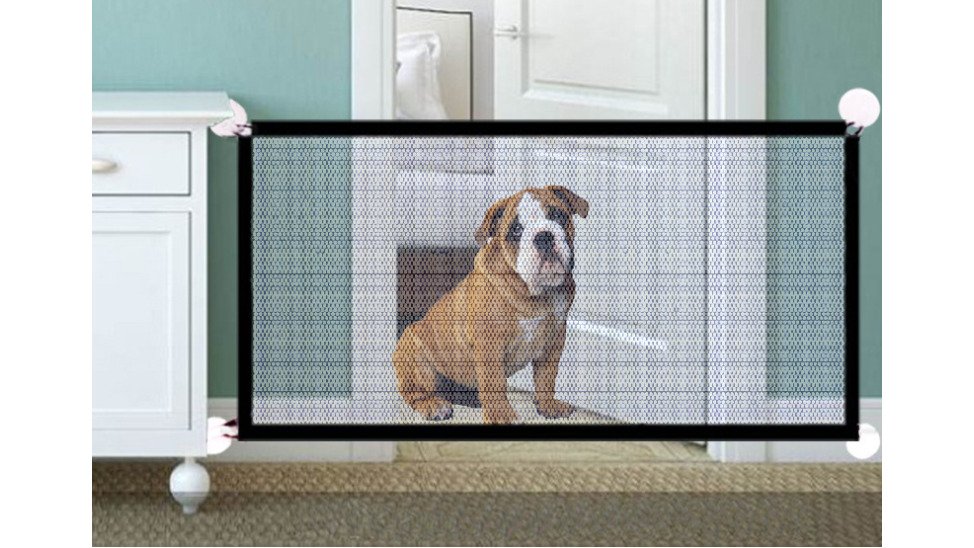
For renters: Pressure-mounted and damage-free solutions. Pressure-mounted gates and tension-based designs are ideal for renters because they require no drilling, no wall anchors, and no permanent changes. The Black Foldable Protection Pet Safety Gate from The Pet Botique exemplifies this approach, unfold it, position it in the doorway, and adjust the width until it's snug. Setup takes two minutes. When you move, you take it with you, and your landlord has no grounds to withhold your security deposit.
If you're renting and considering a hardware-mounted gate, check your lease first. Many landlords prohibit drilling into walls or door frames. If drilling is allowed, use wall cups (small plastic anchors that press into drywall) rather than screw-mounted brackets. Wall cups leave smaller holes that are easier to patch with spackle and paint, a standard security deposit expectation.
For homeowners: Hardware-mounted gates for permanence and security. If you own your home and have a large or determined dog, hardware-mounted gates are worth the installation effort. Use a drill and the hardware provided by the manufacturer.
- Trip hazards: Gates with bottom bars or high thresholds create trip hazards, especially for elderly residents, young children, or anyone with mobility limitations. If you have household members with balance issues, choose a gate with a low-profile or no-trip bottom bar. Test it yourself by walking through quickly while looking away, if you catch your foot, redesign the installation or choose a different gate.
- One-handed operation: You'll often have a dog in your arms, groceries in both hands, or a child on your hip when you need to open the gate. A lock that requires two hands becomes a frustration and gets skipped, defeating the gate's purpose. Prioritize gates with one-handed latches, and position the latch at a comfortable height (typically 36-42 inches) for all household members, including children and shorter adults.
- Swing clearance for mobility aids: If anyone in your household uses a cane, walker, or wheelchair, ensure the gate swings fully open and doesn't create a pinch point. A gate that swings into a narrow hallway or corner can trap a mobility device.
For extra-wide openings. Standard gates max out around 60 inches. For wider doorways or openings, you have three options:
- Custom-width gate: More expensive but purpose-built for your space.
- Stacked configuration: Two gates side by side, each with its own mounting hardware. This requires two separate installation points and two locks, adding complexity.
- Swing gate covering part of the opening: Closes only the portion of the opening your pet would use, leaving the rest open for human passage. This works if your pet doesn't need the full width.
Frequently Asked Questions
What is the best pet safety gate for a wide doorway?
Extra-wide pet safety gates work best for openings 40 inches or larger. Hardware-mounted gates offer the most stable containment for wide spaces, though pressure-mounted options with extension kits can also work. The Black Foldable Protection Pet Safety Gate comes in a Large size (70.9 inches), making it ideal for wide doorways and hallways. Measure your opening first to ensure proper fit and reliable containment.
Are pressure-mounted gates safe for large dogs?
Pressure-mounted gates can work for large dogs, but hardware-mounted options provide superior security. If you choose pressure-mounted, ensure the gate is rated for your dog's weight and check it frequently for movement.
How do I know if a pet safety gate will last without falling apart?
Check product descriptions for material quality and construction details. The Black Foldable Protection Pet Safety Gate uses strong, breathable cloth and durable materials designed for long-lasting use. Read customer reviews about durability over time.
Can I use a pet safety gate on stairs?
Yes, but only hardware-mounted gates are safe for stairway use. Pressure-mounted gates can slip on stairs and create a fall hazard. Hardware-mounted gates with secure mounting hardware prevent movement and keep your pet safely contained at the top or bottom of stairs. Never use a freestanding gate on stairs, as it lacks the stability needed for stairway safety. Ensure the gate has no trip hazards and fits snugly in the stairway opening.


