


 support@thepetbotique.com
Table of Contents
- How to Tire Out a Dog Before Work
- Set Up Dog Enrichment Activities for Home
- Best Interactive Toys for Bored Dogs
- Build a Daily Routine with Rest and Background Noise
- Separation Anxiety vs. Boredom: Know the Difference
- Breed-Specific Enrichment and Safety Monitoring
- Conclusion: Build a Plan That Fits Your Workday
- Frequently Asked Questions
Last Updated: September 17, 2026
How to Tire Out a Dog Before Work
The most effective way to keep dog entertained while working starts before you ever open your laptop. A dog that has already burned physical and mental energy in the morning settles far more easily through a long workday than one who wakes up bored and restless.
That's the core tension most guides miss: enrichment isn't a midday rescue mission, it's a morning investment. This guide breaks down a realistic system you can build around your workday, from pre-work exercise to breed-specific strategies and the difference between a bored dog and an anxious one.
Morning exercise doesn't need to be elaborate. A brisk 20-30 minute walk, a game of fetch, or a structured training session before your first meeting can set the tone for hours. The American Kennel Club's exercise guidance notes that a tired dog is often a well-behaved dog, and the principle holds whether you're heading to an office or a home desk.
What matters most is consistency. A dog who knows the morning routine includes movement and engagement stops waiting anxiously for it to happen.
Set Up Dog Enrichment Activities for Home
Dog enrichment activities for home work best when they're built into your environment, not pulled out on demand. The goal is a space where your dog can self-entertain safely while you focus on work.
Start with a rotation system. Keep three or four different toys or activities available, and swap them every few days so novelty stays high. A toy that's been sitting in a basket for a week becomes interesting again once it's reintroduced.
- Designate a "work zone" for your dog near your desk with a bed, water, and one or two quiet toys
- Keep high-energy toys for breaks and low-energy items for focus hours
- Rotate puzzle feeders and snuffle toys so none become background furniture
- Set a visible boundary, like a baby gate, if your dog struggles to settle near you
A common mistake is leaving every toy out at once. That flattens the novelty and turns enrichment into clutter. Fewer toys, rotated regularly, keep engagement higher.

Best Interactive Toys for Bored Dogs
The best interactive toys for bored dogs are the ones that require your dog to think, not just chase. Passive toys lose their appeal within minutes; toys that dispense, hide, or move unpredictably hold attention far longer because they tap into the same foraging and problem-solving drives your dog would use in the wild.
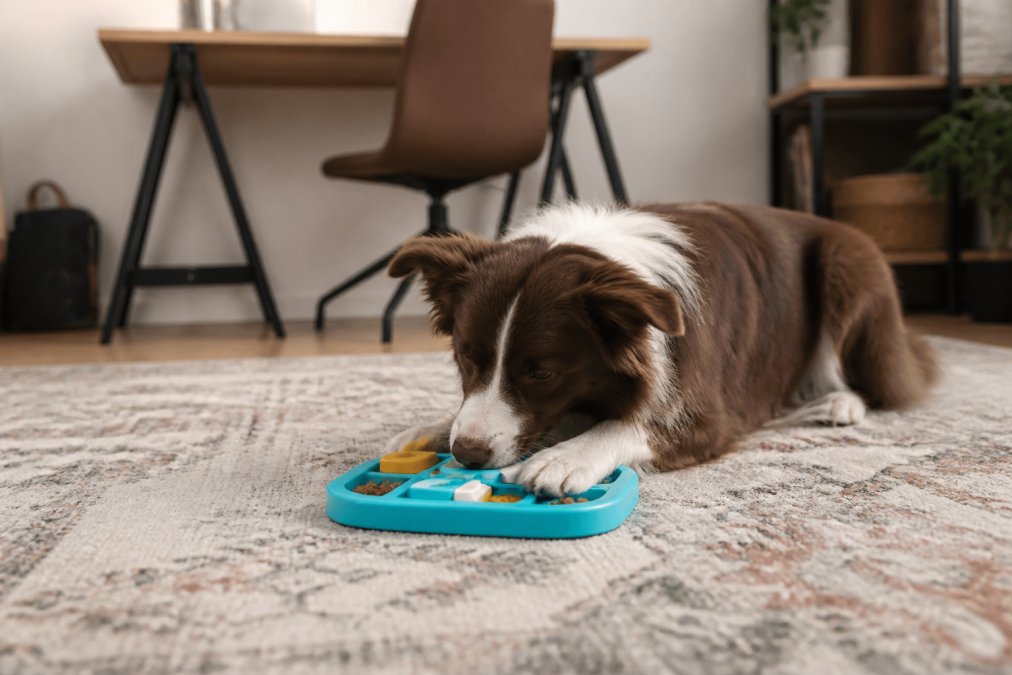
There are three functional categories worth understanding before you buy anything:
- Dispensing toys release food as your dog manipulates them. They turn a meal into a 15-20 minute task and are the most reliable solo enrichment because the payoff is edible.
- Foraging toys hide treats inside fabric or folds, engaging the nose. Nose work is mentally tiring in a way physical play is not, which is why a 10-minute snuffle session can settle a dog longer than a 30-minute walk.
- Motion toys roll, bounce, or wobble unpredictably. These work best for high-drive dogs who need a chase outlet, but they lose value fast if your dog can predict the movement.
What most reviews miss is that durability matters more than novelty. A toy that falls apart in a week is not enrichment, it is a hazard. Before you leave any toy with your dog unsupervised, do a pull test on every seam, tab, and squeaker. If a piece comes loose in your hand, it will come loose in your dog's mouth.

Puzzle Feeders and Treat Dispensers
Puzzle feeders and treat dispensers are the workhorses of solo enrichment. The mechanism is simple: your dog has to solve a problem (slide, lift, roll, or nudge) to release food. Start with an easy setting and increase difficulty only after your dog succeeds consistently, because a puzzle that is too hard gets abandoned and teaches nothing.
A common pattern is that dogs who inhale food and then look for something to destroy do better with a slow-feeder style puzzle that stretches mealtime. If your dog gives up within a minute, the difficulty is wrong, not the dog.
Snuffle Mats and Frozen Treats
Snuffle mats and frozen treats slow your dog down and engage the nose. A snuffle mat hides kibble or treats inside fabric strips so your dog has to root through them, mimicking natural foraging. Frozen treats follow the same principle: freeze a portion of food or a dog-safe spread in a toy and let your dog work at it. It is simple, inexpensive, and buys real quiet time.
Two practical notes. First, freeze in layers rather than one solid block so the treat lasts longer and does not frustrate your dog. Second, rotate frozen toys with dry puzzles so your dog does not habituate to either.
Build a Daily Routine with Rest and Background Noise
A predictable routine is what makes the whole system hold together. Dogs thrive on rhythm, and a workday routine tells them when to expect activity and when to expect rest.
Structure the day in blocks: morning exercise and breakfast, a mid-morning enrichment toy, a lunchtime walk or potty break, an afternoon chew or puzzle, and a wind-down before you finish work. Background noise, like a TV, radio, or white noise machine, can mask outside sounds that trigger barking and help a dog settle.
| Time Block | Activity | Purpose |
|---|---|---|
| Before work | Walk plus training or fetch | Burn physical and mental energy |
| Mid-morning | Puzzle feeder or snuffle toy | Solo mental engagement |
| Lunch | Walk or potty break | Physical reset and connection |
| Afternoon | Chew, frozen treat, or nap | Low-energy settling |
| End of day | Play and attention | Reconnect after work hours |
The rhythm matters more than the exact schedule.

Separation Anxiety vs. Boredom: Know the Difference
Boredom and separation anxiety look similar on the surface, but they need opposite responses. Boredom is a lack of stimulation; separation anxiety is distress at being alone. Treating one as the other makes both worse.
Breed-Specific Enrichment and Safety Monitoring
Breed matters more than most guides admit. A Border Collie and a Basset Hound need completely different enrichment, and using the same plan for both wastes everyone's time. The reason is drive: breeds were developed for specific jobs, and enrichment that mimics that job satisfies a dog in a way generic toys cannot.
-
Herding breeds (Border Collies, Australian Shepherds, Corgis) need problem-solving and jobs. Puzzle feeders, trick training, and toys you can stuff and freeze work well. A herding dog with nothing to do will often invent a job, usually one you will not like.
-
Terriers respond to digging and foraging. A dig box, a snuffle toy, or a treat hidden under a flipped bowl channels the instinct without destroying your yard.
-
Scent hounds (Beagles, Basset Hounds) are happiest with nose work. Snuffle toys, treat-hiding games, and scent trails are the highest-value enrichment for this group.
-
Retrievers want to carry and retrieve. A toy they can hold, toss, and retrieve solo keeps them occupied longer than a stationary puzzle.
-
Toy breeds often need shorter, gentler sessions. Five minutes of engagement several times a day beats one long session, and small mouths need smaller toy openings to avoid frustration.
-
Settled behavior (curled up, slow chewing, sleeping) means your enrichment is doing its job.
-
Pacing, whining, or staring at the door means the plan is not meeting the need, and you should add difficulty or duration.
-
Destroyed toys or chewed furniture means the dog had access to the wrong item at the wrong time, not that the dog is bad.
Conclusion: Build a Plan That Fits Your Workday
The real challenge isn't finding activities, it's building a routine your dog can rely on and you can actually sustain. Start with morning exercise, layer in rotating enrichment, and adjust based on what your dog's behavior tells you.
Frequently Asked Questions
Can I leave my dog for 9 hours while at work?
Most adult dogs can handle 8 to 9 hours alone if they get a bathroom break, but puppies and seniors usually need a midday visit. A dog walker or a few minutes of interactive play can break up the day. If your dog destroys items or barks nonstop, that points to boredom or separation anxiety rather than a simple schedule problem.
What are the best interactive toys for bored dogs?
Puzzle feeders, snuffle toys, and treat dispensers work best because they turn mealtime into a job. Rotate two or three toys each week so the challenge stays new, and put the rest away where your dog cannot see them.
How do I stop my dog from barking while I am on calls?
Give your dog a long-lasting chew or a frozen stuffed toy right before your call starts. Background noise from a TV or radio can mask hallway sounds that trigger alerts. If barking continues, teach the settle command on a mat and reward calm behavior with positive reinforcement. A pet camera helps you spot the trigger while you work.
What are some DIY enrichment activities for dogs?
Muffin tins with treats under tennis balls, cardboard boxes filled with crumpled paper and kibble, and frozen broth cubes in a bowl all count as dog enrichment activities for home. They cost little and target sniffing and problem-solving. Supervise your dog the first time, since torn cardboard and small pieces can become a choking hazard.


