


 support@thepetbotique.com
Table of Contents
- Step 1: Know the Most Common Cat Toy Safety Hazards
- Step 2: Identify Cat-Safe Materials for Toys
- Step 3: Perform a Safety Inspection on Any New Toy
- Step 4: Match Toys to Your Cat's Age and Play Style
- Step 5: Choose Durable Cat Toys for Aggressive Chewers
- Step 6: Rotate Toys and Supervise Play
- Step 7: What to Do If Your Cat Ingests a Toy Part
- Frequently Asked Questions
Last Updated: September 21, 2026
Step 1: Know the Most Common Cat Toy Safety Hazards
Learning how to choose safe toys for cats starts with knowing what actually hurts them, and the same rules apply whether you are shopping for safe toys for cats or inspecting an old favorite. Most injuries come from four things: loose parts, strings, sharp edges, and toxic materials.
Cats explore with their mouths. A toy that looks harmless to you can become a choking hazard in seconds.
The ASPCA Animal Poison Control Center fields thousands of calls each year about pets exposed to harmful substances. Toys are a steady source of those calls.
Here's what to watch for:
- Bells and eyes that pull off with light tugging
- Ribbons, yarn, and string longer than a few inches
- Feathers glued rather than stitched
- Sharp plastic seams or wire cores
- Dyes that rub off on wet fingers
Loose Embellishments and Small Parts
Small parts are the top choking hazard in cat toys. Anything smaller than your cat's throat can lodge there.
Glue fails. Thread frays.
String, Ribbon, and Feather Ingestion Risks
String is more dangerous than most owners realize. Cats swallow it, and it can bunch up in the gut.
Step 2: Identify Cat-Safe Materials for Toys
Cat-safe materials for toys fall into two groups: natural fibers and food-grade synthetics. Anything with unknown dyes or heavy chemical treatment is a risk.
Good options include:
- Untreated wool and cotton
- Sisal and jute rope
- Food-grade silicone
- Solid, unpainted wood
- Non-toxic corrugated cardboard
Materials to Avoid: Toxic Dyes and Synthetic Fibers
Cheap chemical dyes are a real problem in the unregulated market. Many imported toys carry no ingredient list at all.
Avoid these when you can:
- Brightly dyed fabrics that bleed color
- Cheap plastic that smells strongly of chemicals
- Synthetic fibers that shed microplastics
- Painted surfaces that chip or flake
How to Identify Toxic Plastics by Resin Code
Most guides say "avoid toxic plastic" and stop there. That is not useful when you are standing in a store aisle. Here is the mechanism behind the warning.
- #1 PET and #2 HDPE, rigid, low-leach, generally the safest hard plastics for a toy body.
- #3 PVC (vinyl), the one to avoid. PVC is softened with phthalate plasticizers, which are not chemically bound to the plastic and migrate out over time. A cat that chews and mouths a vinyl toy is directly exposed to them. Soft, squishy, glossy plastic with a faint "new shower curtain" smell is the classic PVC tell.
- #6 PS (polystyrene), brittle, sheds hard shards when it cracks. Skip it for anything a cat bites.
- #7 "Other", a catch-all that includes polycarbonate (BPA) and mixed blends. Treat it as unknown unless the maker names the specific resin.
How to Test a Toy for Material Toxicity
Rub the toy with a damp white cloth. If color transfers, the dye is not colorfast, and your cat will ingest it.
- Scratch test. Drag a fingernail across a painted or coated surface. If paint lifts in a curl, it will flake into your cat's mouth.
- Warm-water soak. Submerge a fabric toy in warm water for a few minutes. Cloudy water or a dye halo means the finish is not bonded.
- Twist test on rope. Twist sisal or jute against its lay. If fibers shed in your hand, the cat will swallow them.
Step 3: Perform a Safety Inspection on Any New Toy
A safety inspection takes two minutes and prevents most problems. Do it before the toy touches the floor.
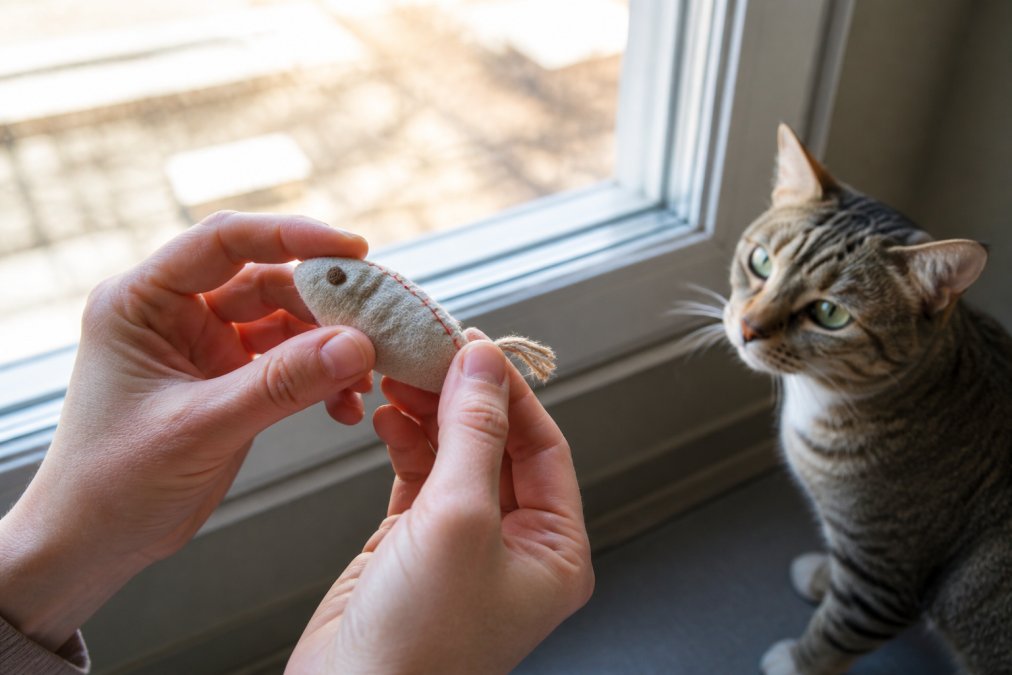
Run through this checklist every time:
- Tug every attached part firmly
- Squeeze the toy for hard or sharp edges
- Check seams for gaps or loose thread
- Confirm no loose string or ribbon
- Sniff for chemical odors
- Look for small pieces that could detach
- Confirm the size is too big to swallow
Step 4: Match Toys to Your Cat's Age and Play Style
The right toy depends on your cat's age, energy, and prey drive. A kitten and a senior cat need very different things, and the reasons are physical, not just behavioral.
Age-Specific Safety Requirements
Kittens (under 1 year). Deciduous teeth are erupting and shedding through roughly 6 months, so kittens chew constantly to relieve gum pressure. Their claws are also small and weak, which means they cannot reliably bat a toy away from their own face. The two failure modes are swallowing and self-injury:
-
Nothing smaller than a ping-pong ball for solo play. If it fits behind the whiskers, it fits down the throat.
-
No string, yarn, or thread, a kitten's barbed tongue cannot spit a strand back out once it is hooked.
-
No wire-core or thin plastic wands; a kitten's bite can snap them into sharp points.
-
Soft plush and fabric kick-toys are the safest default because they give without shattering.
-
Arthritis is common, so a toy that rolls too fast or too far becomes frustrating rather than fun. Slow-rolling balls and stationary puzzle feeders keep the cat engaged without a sprint.
-
Vision and hearing fade, so toys with a bell or crinkle are easier to track, but only if the bell is stitched inside, not clipped on.
-
Senior cats also have weaker enamel and more dental disease, so avoid hard plastic and dense rubber that invite a hard bite.
-
Keep the toy light. A heavy toy is hard to lift with a stiff shoulder.
| Life Stage | Best Toy Type | Physical Reason | Watch Out For |
|---|---|---|---|
| Kitten (under 1 year) | Soft plush, ping-pong-size balls | Erupting teeth, weak claws | Swallowing small parts |
| Adult (1-8 years) | Wands, puzzle feeders | Full jaw and claw strength | Overstimulation, string |
| Senior (8+ years) | Slow-rolling balls, soft toys, crinkle toys | Arthritis, fading senses | Heavy toys, hard plastics |
Match the Toy to Play Style, Not Just Age
Play style matters too. Some cats love to chase. Others prefer to stalk and pounce.
Age sets the safety floor; play style sets the ceiling. Buy for the body first, then for the personality.
Step 5: Choose Durable Cat Toys for Aggressive Chewers
Durable cat toys for aggressive chewers need sturdy construction and no weak points. If your cat destroys toys in days, buy for toughness first.
Look for:
- Double-stitched seams
- Solid wood or thick sisal
- Reinforced attachment points
- No glued-on parts
Step 6: Rotate Toys and Supervise Play
Toy rotation keeps cats interested and gives you time to inspect each toy. Swap out the lineup every week or two.
Step 7: What to Do If Your Cat Ingests a Toy Part
If your cat swallows a toy part, call your vet right away. Do not wait for symptoms.
Warning signs of ingestion include:
- Vomiting or retching
- Loss of appetite
- Lethargy or hiding
- Diarrhea or no bowel movement
- Pawing at the mouth
Post-ingestion emergency protocol:
- Remove the toy and any remaining pieces
- Note what was swallowed and how much
- Call your vet or an emergency clinic immediately
- Do not induce vomiting unless a vet tells you to
- Bring the toy or a photo to the appointment
Frequently Asked Questions
What materials should I avoid when buying cat toys?
Avoid toys with loose embellishments, small glued-on parts, or thin strings that can be swallowed. Skip anything made with toxic chemical dyes or cheap synthetic fibers that shed easily. Materials to steer clear of include soft plastics that crack, untreated wood with splinters, and any fabric that frays quickly. Look for sturdy construction and non-toxic materials instead. If a toy has a strong chemical smell out of the package, that is a red flag for unsafe dyes or coatings.
Are string and yarn toys safe for cats?
String and yarn toys are only safe during supervised play. Cats can swallow string, which creates a serious ingestion hazard and may cause gastrointestinal obstruction. Never leave string, ribbon, or yarn toys out for solitary play. Put them away after each session. If your cat swallows any string, contact your veterinarian right away, even if your cat seems fine. String does not always pass through the digestive tract and can cause internal damage.
How can I tell if a cat toy is durable enough for aggressive chewers?
Check the seams, stitching, and hardware first. Durable cat toys for aggressive chewers use sturdy construction with reinforced edges and no small parts that can pop off. Squeeze the toy and pull gently on any attached pieces. If anything shifts, stretches, or feels loose, it will not survive a determined chewer. Rotate toys often and inspect them weekly for wear and tear. Replace any toy showing cracks, exposed stuffing, or broken pieces immediately.
Should I supervise my cat during playtime?
Yes, always supervise play with wand toys, string toys, and anything your cat can tear apart. Supervised play prevents ingestion of loose embellishments and lets you spot choking hazards early. For solitary play, choose toys with no detachable parts, like a durable scratch board or an automatic ball. Even solo toys need a quick safety inspection before you leave your cat alone with them. Rotate toys regularly to keep play interesting and reduce destructive chewing.
Cats get bored, and bored cats chew. The trick is giving them toys that hold up and stay safe. The Pet Botique carries durable, non-toxic options like the Cat Scratch Board and the Cat Scratch Nest, built to survive real play. Buy any two items and save 10%, with free shipping on orders over $65. Get started with The Pet Botique and give your cat toys you can actually trust.


