


 support@thepetbotique.com
Table of Contents
- How Slow Feeder Bowls Help Dogs That Gulp Food
- Slow Feeder Bowls for Large Dogs: Capacity and Stability
- Slow Feeder Bowls for Small Dogs: Size and Accessibility
- How to Slow Down a Dog Eating Too Fast
- Are Slow Feeder Bowls Safe for Dogs?
- Materials and Construction: What to Look For
- Maze, Ridge, and Obstacle Designs Explained
- What to Avoid When Choosing a Slow Feeder Bowl
- Frequently Asked Questions
Last Updated: October 5, 2026
How Slow Feeder Bowls Help Dogs That Gulp Food
Slow feeder bowls are food dishes with raised ridges, mazes, or obstacles built into the surface, designed to force a dog to work around them for every bite. For dogs that gulp food, that change matters: eating too fast can lead to vomiting, bloating, and in serious cases a life-threatening condition called gastric dilatation-volvulus, which the American Veterinary Medical Association lists as a medical emergency.
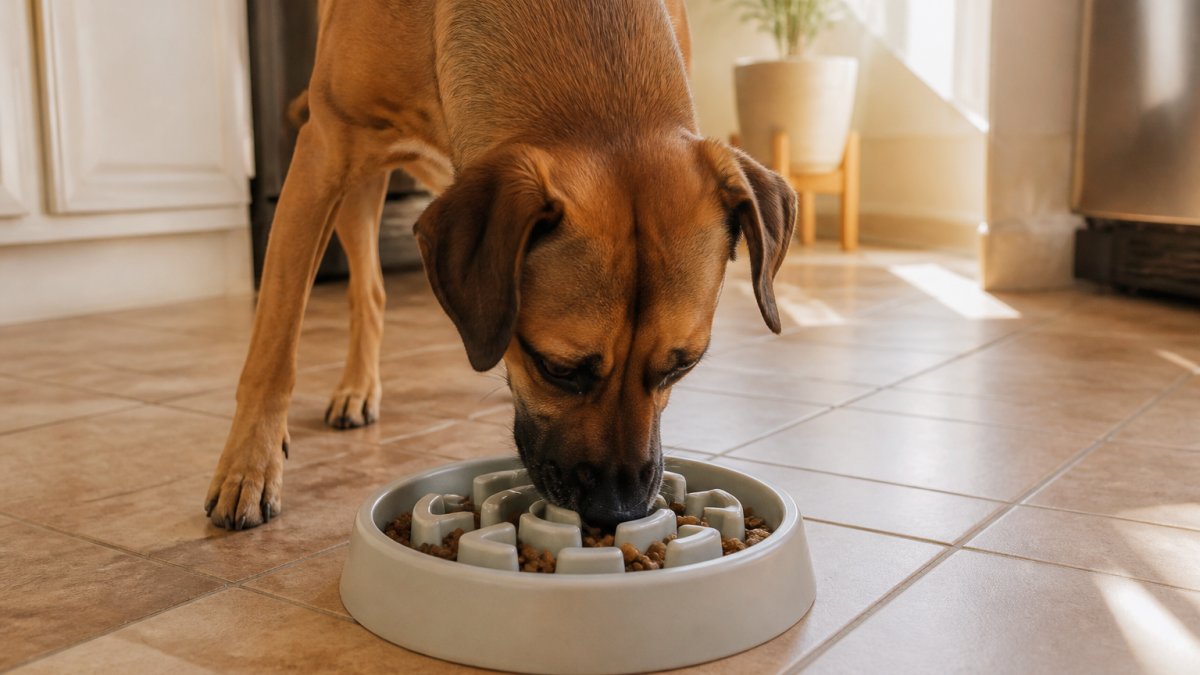
A slow feeder bowl doesn't fix the behavior overnight, but it changes mealtime mechanics immediately.
The mechanism is simple: flat kibble lets a dog scoop multiple pieces with one flick of the tongue, while ridges or a maze force them to work each piece out individually with tongue and nose.
Most owners notice a difference on the first meal: a bowl that took 45 seconds now takes five to ten minutes.
Slow Feeder Bowls for Large Dogs: Capacity and Stability
Large and tall breeds need bigger capacity and a heavier base, a bowl that holds a full meal without spilling and won't slide or flip mid-meal. Look for four-to-six-cup bowls with wide footprints.
Stability is where cheap bowls fail: a lightweight plastic bowl with a shallow base skids when a large dog pushes into it. The fix is a rubber ring or enough weight in the bowl to resist movement.
How We Evaluate Capacity and Stability
We compare bowls on the same repeatable criteria you can run at home in one meal:
- Usable capacity, not stated capacity. Fill to the top of the maze walls, not the rim. A bowl advertised as six cups may hold only four before food spills over the ridges. Measure with a dry measuring cup.
- Footprint-to-height ratio. A wide, low bowl resists tipping better than a tall, narrow one. A base at least as wide as the bowl is tall is a good starting point for large breeds.
- The push test. Set the empty bowl on your kitchen floor and push it with your palm the way a dog leans into a meal. If it slides more than a few inches or tips, it will fail during a real meal.
Non-Slip Bases and Bowl Stability
Non-slip bases come as rubber gaskets that grip the floor or weighted bases that keep the bowl planted. Rubber gaskets lose grip on smooth tile once dust builds up and need a wipe before each meal; weighted bases hold up better on hard floors but are heavier to lift and rinse.
A sliding bowl teaches your dog to chase it: the food scatters, the dog eats faster to grab it, and you're back where you started.
Elevated Slow Feeder Options
Elevated slow feeders raise the bowl off the floor, which some owners prefer for large breeds or dogs with joint issues. The trade-off is stability: a raised bowl on thin legs wobbles more than a floor-level bowl with a wide base. If you go elevated, check that the stand's base is wider than the bowl and that the bowl locks in rather than resting loosely on top.
Matching Bowl Design to Large-Dog Behavior
Design should follow behavior, not just size. A large dog that bolts food needs more obstacles; one that paws or flips bowls needs weight and a wide base more than a complex maze. A long-snouted breed like a Labrador can handle deeper maze walls than a flat-faced large breed. Start with a moderate maze, watch one meal, and adjust: under two minutes means go more complex, walking away means go simpler.
Slow Feeder Bowls for Small Dogs: Size and Accessibility
Small dogs need shallow obstacles and low sides. A bowl designed for a Labrador will frustrate a Chihuahua, and a frustrated dog will give up or flip the bowl.
Flat-faced breeds like pugs and French bulldogs need extra care: short snouts make deep mazes hard to navigate, so shallow ridges work better than a tall maze. If your dog can't reach the food comfortably, they'll stop trying.
Matching Bowl Design to Dog Behavior and Anatomy
Design should follow behavior: a dog that bolts food needs more obstacles, an anxious dog may need fewer, and a long-snouted dog can handle deeper mazes than a flat-faced breed. Start with a moderate maze, watch one meal, and adjust, under two minutes means go more complex, walking away means go simpler.
How to Slow Down a Dog Eating Too Fast
The most effective approach combines the right bowl with a few feeding habits.
- Split meals into two or three smaller portions instead of one large one
- Scatter a portion of the kibble on a snuffle mat or towel for variety
- Use a bowl with a moderate maze first, then increase difficulty
Wet Food, Raw Food, and Mixed Feeding
Wet and raw food change the equation: a maze bowl designed for kibble becomes a paste trap with wet food, and raw diets leave residue in deep ridges. Shallow ridge bowls work better for wet food and rinse easier.
For mixed feeding, put the kibble in the slow feeder and the wet topping in a separate shallow dish. That way your dog still gets the slow-eating benefit without the mess.
Are Slow Feeder Bowls Safe for Dogs?
Yes, when matched to your dog's size and eating style. The main risks come from bowls that are too deep, too complex, or made from materials that scratch and harbor bacteria. A bowl your dog can't comfortably eat from is a bowl they'll try to flip.
What Slow Feeding May Help With, and What It Won't
It helps to separate established guidance from common claims. The American Veterinary Medical Association lists GDV as a medical emergency.
What a slow feeder bowl will not do is treat or prevent a medical condition on its own. If your dog has a history of bloat, regurgitation, or vomiting after meals, or is a deep-chested breed, talk to your veterinarian before relying on a bowl as a fix.
Safety and Accessibility Concerns
Watch for these warning signs:
- Your dog's nose or muzzle is scratched after meals
- Your dog gives up and walks away repeatedly
- The bowl tips or slides during every meal
If any of these happen, switch to a simpler design or a shallower bowl.
Sharp Ridges, Food Trapping, and Choking Concerns
Three specific hazards deserve attention:
- Sharp or hard-to-reach ridges. Run your finger along every interior edge before the first meal. If you feel a rough seam or a sharp corner, return the bowl. A dog working kibble out of a tight corner can scrape their muzzle or tongue.
- Food trapping. Deep crevices that hold kibble after a rinse are a bacterial growth problem, especially with wet or raw food. If you can't see and reach the bottom of every channel, the bowl is too complex for wet food.
- Choking and gulping. A slow feeder reduces gulping, but a dog who tries to bite a whole mouthful out of a narrow channel can still gulp. Watch the first few meals and confirm your dog is taking individual pieces, not scooping.
Elevated Designs: Who They Suit
Elevated slow feeders are not automatically safer. They help dogs who already eat comfortably at height or have joint issues that make floor-level eating painful, but hurt dogs who paw at their bowl, since a raised bowl on thin legs tips more easily than a weighted floor-level bowl. If unsure, ask your veterinarian, especially for large or deep-chested breeds.
When to Consult Your Veterinarian
Reach out to your veterinarian if your dog vomits after most meals, regurgitates undigested food, shows pain or restlessness after eating, or is a deep-chested breed with a history of bloat. A slow feeder bowl is a mealtime tool, not a diagnosis.
Materials and Construction: What to Look For
Food-grade stainless steel and high-quality plastic are the two materials worth considering. Stainless steel resists scratching, doesn't hold odors, and is dishwasher-safe. Plastic is lighter and cheaper, but lower-grade plastic scratches over time and traps bacteria in those scratches.
Look for these markers of quality:
- Food-grade stainless steel or BPA-free plastic
- A rubber or weighted non-slip base
- Smooth interior surfaces with no sharp edges
Double-wall construction adds durability and helps the bowl hold its shape under a large dog's weight. Heavy-duty construction matters more for large breeds than small ones.
Maze, Ridge, and Obstacle Designs Explained
Three main designs dominate the category, and each suits a different dog.
| Design | Best For | Difficulty | Cleaning |
|---|---|---|---|
| Shallow ridges | Small dogs, flat-faced breeds, wet food | Easy | Easy |
| Spiral or maze pattern | Most dogs, moderate gulpers | Moderate | Moderate |
| Deep puzzle obstacles | Large breeds, fast gulpers | Hard | Harder |
Ridge bowls use gentle bumps that slow eating without much frustration. Maze bowls use a spiral or labyrinth pattern that forces the dog to navigate around walls.
The ASPCA's pet care guidance notes that mental enrichment during meals supports overall wellbeing, which is why puzzle-style feeders double as boredom busters.
What to Avoid When Choosing a Slow Feeder Bowl
The biggest mistake is buying for looks instead of fit. Here's what to skip:
- Bowls with deep crevices that can't be rinsed clean
- Thin plastic that flexes under a large dog's weight
- Bowls with no non-slip base
For owners who want to combine feeding with enrichment, our Interactive Feeding Toy works as a puzzle feeder for dogs of all sizes and breeds, encouraging the same slower, mindful eating a slow feeder bowl provides, with added mental stimulation. For travel or days out, our Pet Dog Water Bottle Feeder dispenses water and food on the go.


Frequently Asked Questions
What is the best bowl for slow feeding dogs?
The best slow feeder bowls use a maze or ridge design that forces your dog to work around obstacles to reach kibble. Look for food-grade stainless steel or BPA-free plastic, a non-slip rubber base, and a capacity that matches your dog's meal size. For large dogs, choose a bowl that holds at least 4 cups and stays put during meals. For small dogs, pick a shallower design they can reach without straining.
How do slow feeder bowls work?
Slow feeder bowls add ridges, mazes, or obstacles that break up the food pile. Instead of gulping a mound of kibble in seconds, your dog must navigate around these barriers to reach each piece. This turns one large bite into many smaller bites, extending mealtime from under a minute to five or ten minutes. The result: less air swallowed, slower eating speed, and more mental stimulation at each meal.
Are slow feeder bowls safe for dogs?
Slow feeder bowls are safe for most dogs when sized correctly. The main risks are frustration in dogs with short snouts or bowls that are too deep for small breeds. Choose a bowl with shallow ridges for flat-faced dogs and a capacity that matches your dog's meal. Always supervise the first few meals and check that your dog can reach food without pressing their nose painfully against the bowl's sides.
How do I choose the right slow feeder bowl for my dog?
Start with capacity: measure how many cups you feed per meal, then pick a bowl that holds at least that much. Next, match the maze depth to your dog's snout length. Flat-faced dogs need shallow ridges; long-nosed breeds can handle deeper mazes. Finally, check the base. A rubber non-slip ring keeps the bowl steady, especially for large dogs or hard floors. Dishwasher-safe materials make cleanup easier.
Picking the right slow feeder bowl comes down to fit: your dog's size, their snout, their eating speed, and how much cleanup you're willing to do. Get those four right and mealtime stops being a race.
At The Pet Botique, we stock durable feeding and enrichment essentials designed to hold up to daily use, and you can save 10% when you buy any two items, with free shipping on orders over $65. Browse our feeding and toy collection to find the right match for your dog's pace.


